 बुधबार, ०२ पुस २०८२
Kathmandu - Students, alumni, and parents bed farewell to Mr Indra Bahadur Uparkoti, the retired Head Teacher of Gandaki Secondary School in Runchet, Dharche Rural Municipality (RM), of North Gorkha, on a helicopter offering him a ride on a helicopter. The people of the Runchet saying that ‘He taught many of us to fly in 40 years of his teaching’ honored him offering flight to his house quoted the news. Former students and parents raised funds to arrange flights for HT Rupakoti who was born in Finam, Gorkha and became a teacher there, to fly from Runchet to Kathmandu on a helicopter and from Kathmandu to Bharatpur by an aeroplane.
Khotang's Halesi Tuwachung Municipality has decided to provide local allowance to public school teachers. It has been decided to provide local allowances for teachers and employees of 86 schools in the Municipality, adding an annual expenditure of US$119.2 thousand, the news mentioned.
The news that the number of teachers leaving the profession has been steadily increasing in Gulmi over the past few years has been repeated last week. According to the District Education Development and Coordination Unit (DEDCU), Gulmi, eight teachers have resigned in four months (July-November) of the current fiscal year. A total of 132 teachers have resigned from their posts since 2022, mentioned the news. According to Mr Thaneshwor Ghimire, head of the DEDCU, the declining attraction towards the teaching profession and the increasing trend of foreign employment have increased the number of resignations, the news quoted.
Narayani Primary School in Kawasoti Municipality, Laugai, the headquarters of Nawalpur district, is on the verge of being closed down as the number of student decreases every year, there was the news. This school, which is attended by the children from underprivileged families including Majhi, Musahar communities, used to have up to 145 students, but now only nine are studying. Even the school Head teacher has resigned and become active in politics.
The above incidents (first two and latter two) are somewhat paradoxical but the topic demands serious thought. Incidents like this, that take place from time to time, provide an example of respect for those who lament that teaching profession is not dignified. It has also sent a profound message to teachers who reiterate that there is no system of reward and punishment but do not perform well that the real reward for teachers comes from parents and students, rather than employees or anyone else!
Nonetheless, these examples are exceptions. The teaching profession has not been able to attract competent individuals. Few national and few global systems are responsible for this. Mainly due to increasing consumerism, money has become an extremely important aspect of life. Dignity, desires, aspirations, and values have been secondary.
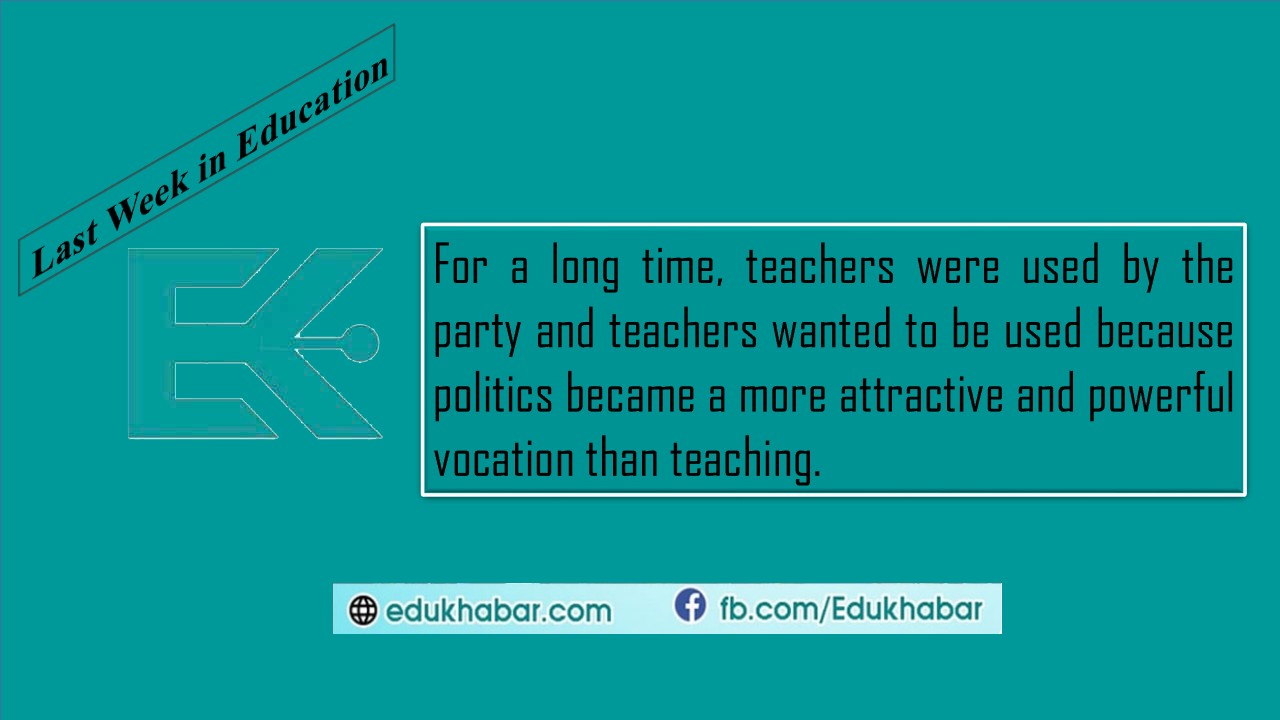
The profession was not rewarding compared to the time and effort that teachers have to put in their work. Private schools remained an attractive choice for parents, primarily because the teachers themselves did not produce results in public schools. Attraction to private schools has also downplayed the prestige of public teachers. Here, profit driven efficiency outshines compassion of teaching. Further, for a long time, teachers were used by the party and teachers wanted to be used because politics became a more attractive and powerful vocation than teaching. If nothing else, politics continued to provide protection even when teacher was inert in teaching; because children of the influential policy-making class did/do not attend public schools.
While demand for conventional education is increasing, institutional learning is no longer a prerequisite for progress that needed knowledge due to technology and the convenience it brings to acquire knowledge. Except for very young children, the knowledge gap between teachers and students is narrowing every day. The Task of institutional education has now reduced to a matter of sequencing and giving a structure, which appears to be more of a management issue than teaching as a vocation. Issues such as this are making education in the current context further challenging.
Although the Federal government remains oblivious (except allocating budget and dealing with unionized teachers) towards education overall, monitoring of teachers has increased since the responsibility for school education was brought under the purview of Local Governments. It is well known that a high number of teachers have two careers, teaching being one, and it is reported that they are leaving the teaching profession if they can pursue another career better. However, there are examples of some municipalities taking steps that the Federal Government would have no encourage or will power, such as increasing allowances to teachers or providing motorcycles to Head Teachers or laptops to teachers.
Looking for more reasons for the teachers leaving the profession: formal processes have become increasingly cumbersome, experienced around the world. The process of ‘governing by numbers’ has also infatuated teachers who only aspire to do the core of teaching. (For more details and information, see the cover story of the November 2025 issue of Teacher Monthly).
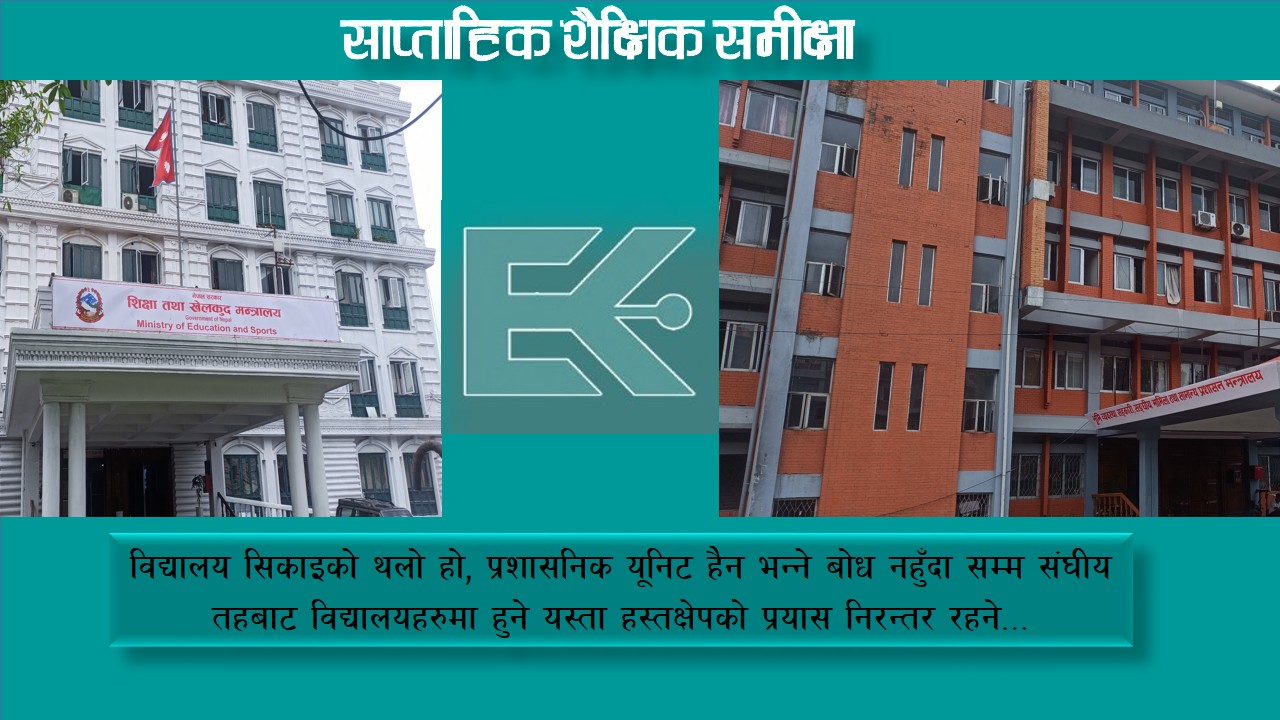
In many schools, the Government does not provide necessary expenses and does not even allow them to collect contributions in the name of free education. This has also created bureaucratic hassle also to them who wish to do better in public school (and excuses to those who do not wish to do much). Dwindling popularity of public schools especially decreasing number of children is also a psychological detractor for teachers.
For the Minister of Education and his team who want to do something tangible, this issue should be on their agenda. He should create a roadmap on how to increase the attraction and dignity of teaching profession. He/they should think out of the box. He should not carry too much of the old baggage.
Due to the lack of toilets at Gyankunj Basic School in Ranichiura, Sanibheri RM, Rukum West, students are defecating in fields, forests, and rivers, the news came. After the dilapidated toilet was completely destroyed by the earthquake with the epicenter in Jajarkot on November 3, 2023, students here are facing a lack of places to defecate and urinate.
Students of Kyaulethana Basic School in Jyamire, Melamchi Municipality, Sindhupalchowk have started earning an income by weaving doko (big vase to carry stuff made by bamboo splits) and chakati (mat of usually straw to sit on) along with their studies, published the news. Every Friday, 108 students from grades 1 to 8 are taught not only text-book but also how to grow vegetables, cash crops, and other crops in the garden, in addition to doko and chakati, mentioned the news.
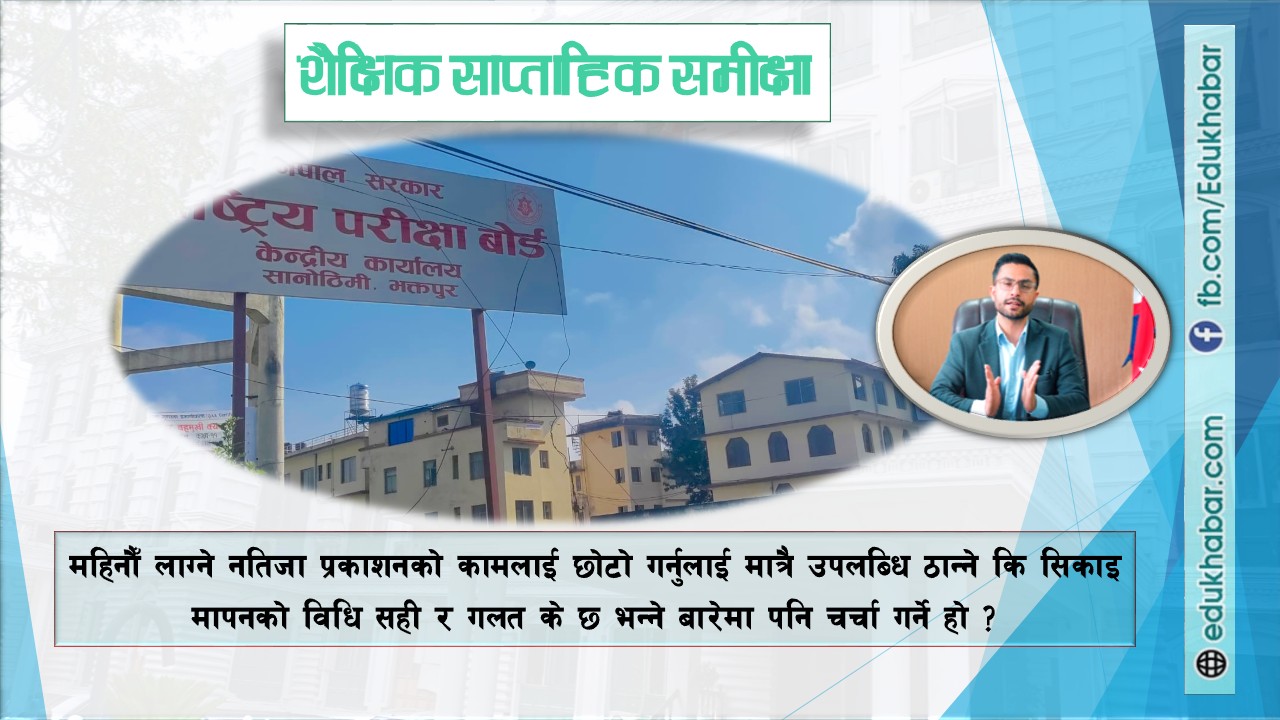
The National Examination Board (NEB) has asked all secondary schools to make necessary arrangements to correct the birth certificates of students who are ineligible to participate in the Secondary Education Examination (SEE) due to their necessary minimum age, there was the news. According to the sixth amendment to the Education Regulations 2003, a person must be 14 years of age by mid-April to participate in the SEE, the news quoted. But last week's news shows that this is not a solution, but rather an added complication. (https://www.edukhabar.com/news/17074) The NEB issued this directive despite its unwillingness? to implement the decision to remove the age bar for appearing in the SEE examination through a Ministerial decision of March 2022.
The 'Interest-Free Educational Loan' program launched by Dadeldhura's Parshuram Municipality with the aim of ensuring that poor and talented students do not face financial difficulties in pursuing higher education is becoming effective, the news covered. The municipality decided to provide loans of up to US$ 3,450 equivalent against academic certificates to those who wish to pursue technical and vocational education, and 30 students have taken the loan, mentioned the news.
Two thousand two hundred and nine students have been initiated in Kathmandu University (KU)'s 31st convocation. Among them are some 200 foreign students including from Australia, Austria, Bangladesh, Bhutan, Britain, India, Japan, Malaysia, Maldives, Mexico, Namibia, Russia, Spain, Sri Lanka, Sweden, the United States of America and Vietnam. Speaking at the University's 31st convocation ceremony, Prime Minister and ex-officio Chancellor Sushila Karki said that the government is working to change the system of having the Prime Minister as the Ex-officio Chancellor of the universities in order to end politicization in universities, the media covered.
The Secretariat of the Himalayan University Consortium (Himalayan University Network) has been established in the campus of Kathmandu University (KU) in Dhulikhel, the news came. The International Center for Integrated Mountain Development (ICIMOD) has formally handed over the secretariat to Kathmandu University. According to the news, the Himalayan University Consortium has evolved into a network of more than one hundred universities and educational institutions in and around the Hindu Kush-Himalayan region.
The failure of the student organizations close to the party, to become creative and student-friendly has also raised questions about the credibility of student leaders Onlinekhabar news portal published. Academic issues such as curriculum, employment-related education, and human resource demands in the market have not been the priority for student organizations, mentioned the news.
KB Basnet wrote in Gorkhapatra under the title "Education, the Basis of Development" that although education is the basis of every person's life, if it is only theoretical, it could not be useful in life. Similarly, Sujit Sapkota wrote an article questioning the quality of Nepal’s legal education.
In an article written in Kantipur by Samiksha Acharya titled "Tribhuvan University's Mistake, Student's Pain", she mentioned the burden and hasselesshe experienced because of the TU.
Purpose of this news review is to classify and synthesize the educational content of the week and provide objective comments from the point of view of social justice and creative pedagogy including the environment. It is aimed to the policy makers and stakeholders to help make informed decisions. In this joint effort of the Center for Educational Policies and Practices (CEPP) and EduKhabar, material from daily newspapers - Kantipur, Gorkhapatra and The Himalayan Times, online news portals - Online Khabar, Setopati and Ratopati and the 8 o'clock news of Nepal Television and 7 o'clock news of Himalaya Television is summarized and presented with commentary on relevant issues. We have covered the contents from 6-12 Dec 2025 in this issue and this often is the translated version of Nepali edition - The Editor.
Read this analysis in Nepali : हेलिकप्टर चढाएर शिक्षकको बिदाई !
Read last week's content : Last week in Educationn


प्रतिक्रिया