 विहीबार, २५ मंसिर २०८२
Kathmandu - A photo of an office assistant teaching in a classroom at Janachetana Basic School in Laljhadi Rural Municipality of Kanchanpur, which was facing problems with regular classes due to a shortage of teachers, has been published in Gorkhapatra.
There is a shortage of teachers for mathematics, Science, and English in public schools in Kalikot. According to the news, Rupadevi Secondary School in Malkot Uchhav, Narharinath Rural Municipality of has not been able to find a teacher for mathematics despite advertising for 18 times. This is the 19th time this remote school has advertised for the teacher for failing to fill a Math teacher quota it received under the federal grant last year.
Gorakhpatra published an editorial ‘The Pain of Teacher Shortage’ which concluded that ‘it is not easy to find math, science, and English teachers across the country, and even if teachers are found, it is difficult to retain them’. Although there are talented students in higher education in English, mathematics, and science, such students go to countries such as Australia, the US, and Canada and they work and live there which makes the shortage human resource, the editorial mentioned.
To show that the state is trying to manage the problem of having many teachers in some places and few in others due to the distribution of teaching positions, the government sometimes forms a task force to allocate teaching positions based on the student-teacher ratio. The task force also determines the needed numbers of teachers and makes suggestions for solutions. However, those suggestions are not implemented.
A task force formed by the government in 2018 under the coordination of Former Secretary Dr. Mahashram Sharma had suggested adding about 55,000 teacher positions and converting ‘relief quotas’ into positions. However, the suggestion was not implemented. Another task force was formed under the chairmanship of former Education Secretary Dipendra Bikram Thapa last year. Although the report has not been formally made public, the task force has submitted a report to the government indicating a shortage of approximately 57,000 teachers, it is learnt. The government does not seem to be interested in implementing this report either. This shows that the governments are not serious about solving the problem of teacher shortage.
Rather, all the interest groups benefit from this shortage: teachers don’t have to be responsible because there are no adequate teachers. Bureaucrats can blame politicians for not solving the problem and politicians can pretend to be working and both continue favoring their kin and partisans. If the number of teachers distributed based on the set criteria, shortage will remain but won’t be so much. It is well understood that the government is not going to increase the positions. When there is shortage of teachers and public schools don’t function. This is a great opportunity for the private schools who have influence over both bureaucrats and politicians to go on the status quo. Almost everybody who have influence in public affairs, have their children in private schools.
There is a provision that there should be one teacher for every 50 students in Madhesh, 45 in the hills, and 40 in the Himalayas. Based on the number of students, there are currently fewer teachers and more students in the accessible areas of the Tarai and hills, and more teachers than students in the hilly, mountainous, and remote areas.
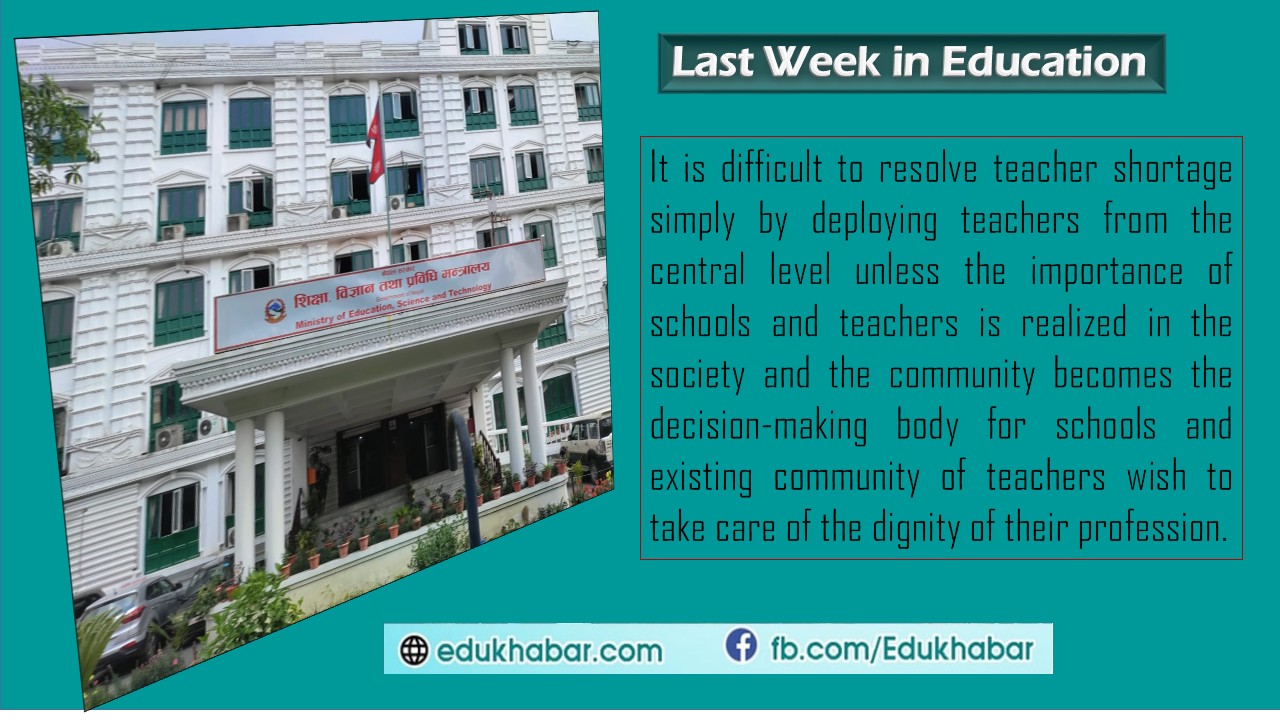
It is difficult to resolve teacher shortage simply by deploying teachers from the central level unless the importance of schools and teachers is realized in the society and the community becomes the decision-making body for schools and existing community of teachers wish to take care of the dignity of their profession.
Nobody is under pressure to look for a solution for teacher shortage. Potential teachers go abroad or even who remain here are not willing to teach because it is under paid in comparison to the demands of the position. There is no effort of popularizing teaching and the faculties those produce teachers do hardly anything other than distributing degrees. Those who are only after any secure job resort to teaching and creativity is not coming from the teaching community or institutions like Teacher Service Commission to solve this problem.
It will be a big shield for those producing excuses: teacher shortages is a problem worldwide and are likely to worsen in the future. There is no relative shortage of teachers in private schools as they are concentrated in cities and students studying higher can teach in private schools as a means of earning a living. They don’t need degrees or exams but producing results by hooks and crooks. They are well controlled by the owners as their stake is in producing scores and being responsible to parents on everyday basis. There is nobody responsible in those public schools. Nobody’s job is at stake, nobody is deprived of salary let the moral responsibility alone! Only the solution lies in the power of existing teachers who give some worth to self-dignity and start acting to preserve it. They can find solutions if they are serious.
Now, this shortage has been an object of blame game: federal government while tries to retain the power of hiring teachers, does not allow the local bodies to hire teachers under federal grants, in general. When local bodies hire teachers partisanship and kinship are the main criteria. Municipalities trying to manage the affair of teachers fairly are strongly resisted by the teachers. There is no pressure also at the local level to improve public schools as most of the policy makers children are in private schools. Those parents sending their children in public schools are mere voters without unheard voices. At the end, of course, they are blamed for not being ‘aware’ of the importance of education and not paying attention to their children’s education that hardly pays back the worth of effort.
Nepal Academy of Science and Technology (NAST) gave training to 42 science teachers of Chandragiri and Tokha Municipality aiming to enhance the capacity of science teachers to provide quality education to students by using the latest technology such as AI in teaching, there was the news.
Eleven students from Kalika Manav Gyan Secondary School, a public school in Butwal, have been successful in receiving free scholarships for MBBS and a total of 42 students have been successful in receiving scholarships for undergraduate studies in various faculties, the news published.
At Punya Secondary School in Rajarani, Chaubise Rural Municipality, Dhankuta, the teachers and students have been instrumental in improving the English language through practical of grammar, vocabulary, and every skill included in the curriculum, the news quoted.
The riverbanks are being strengthened by building an organic embankment with bamboo, grass, and local species of plants because Betaha settlement, which has about 80 households in Lahan Municipality, and its primary school suffer from flooding from the Betaha River every year. This made school and settlements are free from the fear and damage of the Betaha river flowing from the Chure, there was the news.
Minister of Education Science and Technology Mahabir Pun has issued a notice to municipalities to form School Management Committees as per the rules and warned that grants will be stopped if school management committees is not formed, quoted the news.
The Medical Education Commission has allocated the quota of postgraduate students for government and private medical campuses. The government campuses are given more than 1,000 seats and private campuses are given a little less than 1,000, the news mentioned.
Prof. Dr. Krishna Kant Parajuli wrote in Gorkhapatra that the concept of operating Nepal's universities through a Board of Trustees have envisioned new possibilities for educational reform.
Similarly, Shobhakhar Kandel has wrote in Gorkhapatra that becoming a patriotic citizen with a practical attitude is to become a good citizen who works for the welfare of the family, society, and the nation.
If public schools are to be improved, the local governments must show strong willpower, Prem Narayan Bhusal has wrote in Gorkhapatra.
Surya Pandey has wrote in Gorkhapatra under the title "A Different View of the Tribhuvan University (TU) Assembly" that this time's TU Assembly was not filled with political speeches and political infighting among the members of the assembly.
The government has appointed Professor Gyan Bahadur Thapa as the Secretary of the University Grants Commission. According to the news, Professor Thapa teaches mathematics at Pulchowk Campus of the Institute of Engineering.
The Department of Consular Services, Ministry of Foreign Affairs, has created a portal to collect details of students who have encountered problems while attending educational institutions in the United Arab Emirates (UAE) for higher education in Abu Dhabi where 24 victims have filed a complaint specifying the names of the consultancies and the educational institutions in the UAE, quoted the news.
Australian Ambassador Leanne Johnston and Education Secretary Chuda Mani Poudel have announced the Australian Awards given Scholarships to 13 public service professionals, 11 women, and 2 people with disabilities who commence their postgraduate studies by Australian Government, the news came.
A state-of-the-art building is being constructed at Sinjali Secondary School in Shaheed Lakhan Rural Municipality, Gorkha, with an investment of one US$ 7.1 million from the Chinese government. The school building will be completed and handed over to the school by November next year, mentioned the news.
Pakistani Ambassador Abrar Hashmi has inaugurated a new computer laboratory at Gyanodaya Secondary School in Bafal, Kathmandu. The new laboratory has 42 computers and new furniture, the news published.
Purpose of this news review is to classify and synthesize the educational content of the week and provide objective comments from the point of view of social justice and creative pedagogy including the environment. It is aimed to the policy makers and stakeholders to help make informed decisions. In this joint effort of the Center for Educational Policies and Practices (CEPP) and EduKhabar, material from daily newspapers - Kantipur, Gorkhapatra and The Himalayan Times, online news portals - Online Khabar, Setopati and Ratopati and the 8 o'clock news of Nepal Television and 7 o'clock news of Himalaya Television is summarized and presented with commentary on relevant issues. We have covered the contents from 29 Nov – 5 Dec 2025 in this issue and this often is the translated version of Nepali edition - The Editor.
Read this analysis in Nepali : शिक्षक अभावको समस्या बढ्दो
Read last week's content : Last week in Educationn


प्रतिक्रिया