 शुक्रबार, ०९ असोज २०८३
Prime Minister Balendra Shah’s speech to the 81st session of the United Nations General Assembly on 24 September 2026 sought to place Nepal’s recent climate-related disaster within a larger discussion on climate justice, global economic inequality, regional cooperation, and the responsibilities of the international community toward vulnerable developing countries.
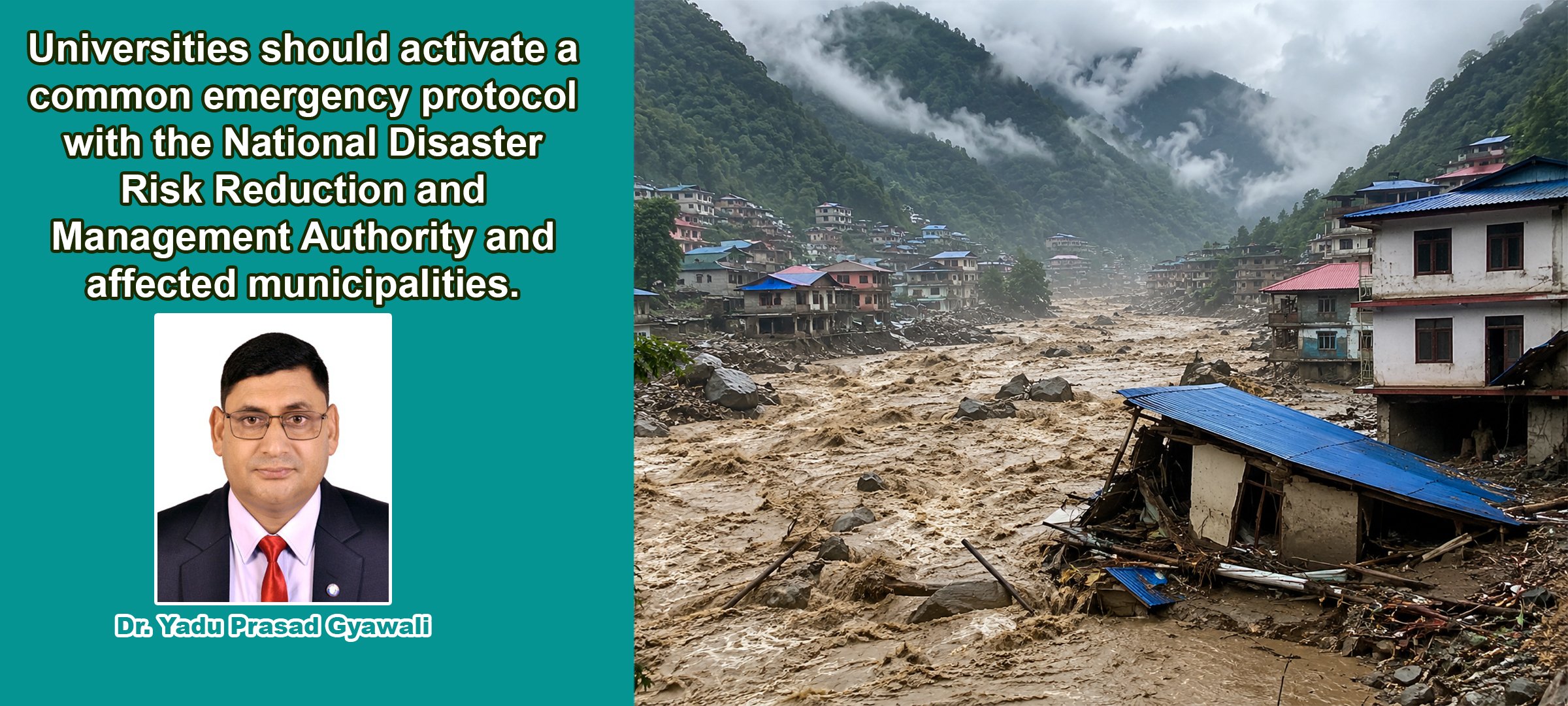
The speech connected Nepal’s immediate humanitarian experience to structural questions of education, development, public finance, international governance and multilateralism. The Prime Minister began by describing the devastation caused by the recent Bhotekoshi-Trishuli disaster and highlighting the human and economic cost of floods, landslides and ecological instability in the Himalayan region. He spoke of families still awaiting news of missing relatives, communities struggling to recover from physical devastation, and the setback to Nepal’s progress toward the Sustainable Development Goals.
From this perspective, Nepal’s education system needs to move beyond a narrow emphasis on knowledge transmission, examinations, and certification toward education for resilience, sustainability, responsibility, and transformation.
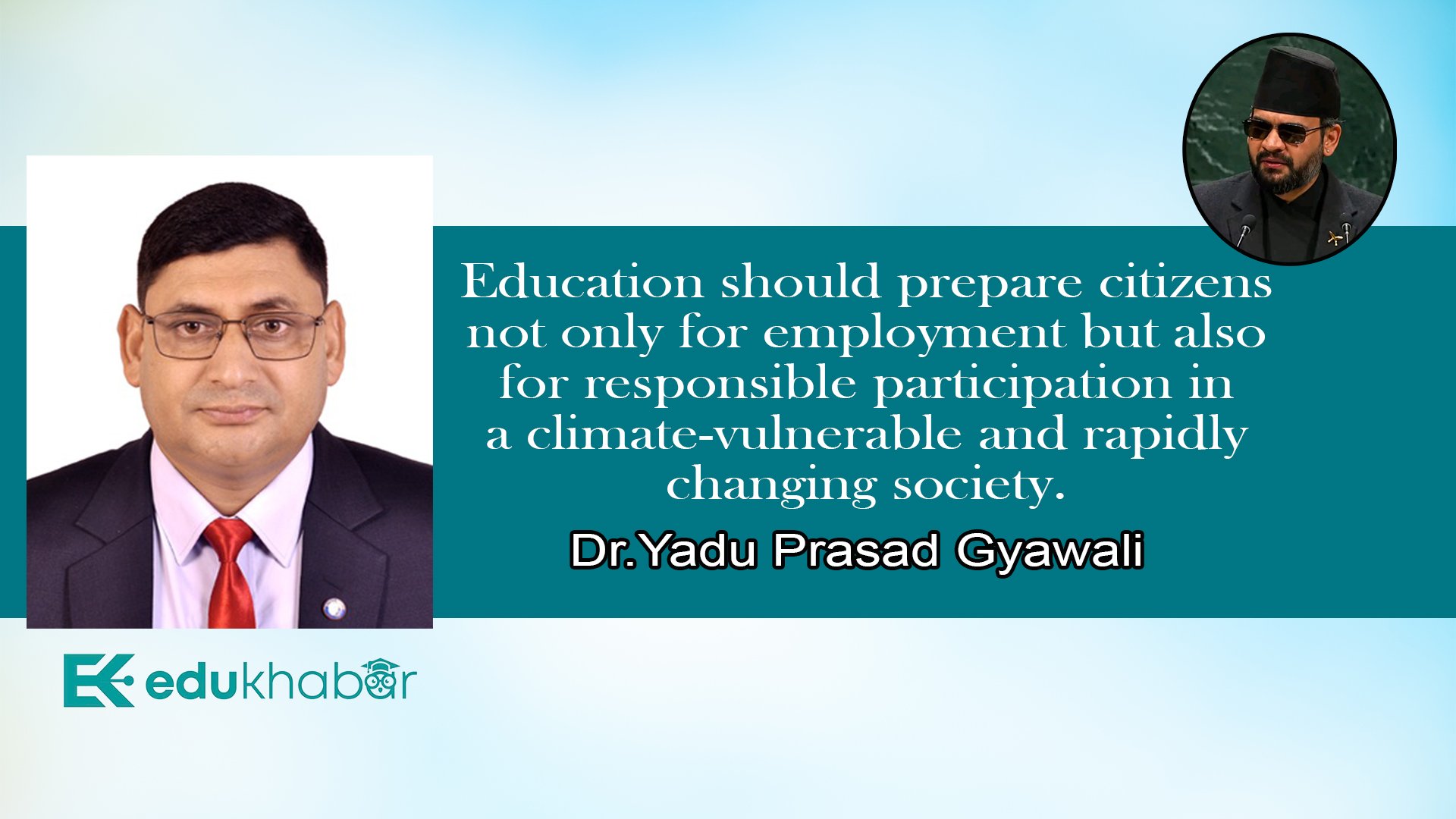
From an educational perspective, the Prime Minister’s address to the UN Assembly conveys a strong message that education must prepare citizens not only for employment, but also for responsible participation in a climate-vulnerable and rapidly changing world. By linking climate disasters with Nepal’s development setbacks and the Sustainable Development Goals, the speech highlights the need for education that builds climate awareness, practical problem-solving skills, disaster preparedness, social responsibility, and resilience.
Educational and Philosophical Implications
The Prime Minister’s address also carries important implications for education. By linking climate disasters with development setbacks, infrastructure losses, livelihoods, and the Sustainable Development Goals, the speech suggests that education should prepare citizens not only for employment but also for responsible participation in a climate-vulnerable and rapidly changing society.
From this perspective, Nepal’s education system needs to move beyond a narrow emphasis on knowledge transmission, examinations, and certification toward education for resilience, sustainability, responsibility, and transformation. Students require climate awareness, practical problem-solving abilities, disaster-preparedness skills, social responsibility, and the capacity to respond constructively to environmental and social change.
Education, from this perspective, should help develop citizens who can critically examine social and environmental problems and participate responsibly in their transformation.
This educational orientation can be understood through several philosophical perspectives. First, it reflects pragmatism, in which learning is connected to experience, inquiry, and the practical solution of real-world problems. In Nepal’s context, this means linking education with local challenges such as floods, landslides, glacial risks, agriculture, water management, environmental conservation, and disaster preparedness.
Second, the speech reflects aspects of social reconstructionism through its emphasis on climate justice, inequality, accountability, and the representation of vulnerable communities. Education, from this perspective, should help develop citizens who can critically examine social and environmental problems and participate responsibly in their transformation.
Third, the concern for human dignity, livelihoods, social protection, and future generations points toward a humanistic orientation to education. Education should contribute to the development of individuals and communities capable of living with dignity, empathy, responsibility, and resilience.
Finally, the call to move from ad hoc disaster response toward preparedness, innovation, and stronger institutions is consistent with transformative education. Such an approach encourages learners not merely to acquire information but to reconsider assumptions, solve problems, participate in society, and contribute to meaningful change.
Taken together, these perspectives suggest a broader educational transition: from memorisation to inquiry, from examination to problem-solving, and from passive learning to socially responsible action.
Climate Change: A Development and Fiscal Challenge
For countries like Nepal, the impact of climate-induced disasters is much more than loss of life and property. Destruction of roads, bridges, schools, hydropower facilities, agricultural land and private assets decreases productive capacity and adds to the already constrained public finances.
The Prime Minister was right to say that vulnerable countries are often forced to borrow to rebuild infrastructure damaged by a climate crisis they did little to cause. Repeated disasters can divert public expenditure away from health, education, employment creation, and productive infrastructure toward reconstruction. They can widen fiscal deficits, undermine debt sustainability, and shrink resources available for long-term development. At the household level, disasters wipe out savings, destroy agricultural income, and push vulnerable families back into poverty.
The characterisation of climate catastrophe as a “development emergency” therefore deserves serious consideration. At the same time, Nepal’s international advocacy will carry greater weight if it is accompanied by rigorous national assessments of climate-related loss and damage, transparent reconstruction priorities, and clearly defined financing requirements. Climate justice requires moral arguments, but successful international negotiations also require credible data, institutional capacity, and implementable proposals.
One of the speech’s most important features was its attempt to move Nepal’s international narrative beyond traditional appeals for post-disaster assistance. The Prime Minister summarised the challenge in six words: “Relief. Rehabilitation. Reconstruction. Responsibility. Reparation. Resilience.”
The first three represent the conventional sequence of disaster management. The latter three introduce broader questions of responsibility, financing, and long-term preparedness. Historically, disaster-affected developing countries have relied on humanitarian support, concessional finance, and reconstruction assistance. The contemporary climate debate increasingly asks a more fundamental question: who should bear the cost of climate-related losses when responsibility for historical emissions is highly unequal?
The principle of common but differentiated responsibilities and respective capabilities, which the Prime Minister referenced, provides an established foundation for this discussion. For Nepal, the policy implication is that climate finance should increasingly support adaptation, resilience, and loss-and-damage recovery through predictable and accessible mechanisms.
Nepal should, however, avoid presenting climate finance solely as compensation. A stronger diplomatic position would combine demands for international responsibility with clear evidence of domestic commitment to efficient, transparent, and climate-resilient investment.
A Himalayan Climate Resilience Mechanism
Perhaps the most concrete proposal in the address was the call for a Himalayan Climate Resilience Mechanism involving Nepal, India, and China. The Prime Minister proposed cooperation in satellite-data sharing, monitoring of dangerous glacial lakes, joint early-warning systems, and coordinated disaster response.
The Himalayan ecological system does not respect political boundaries. Rivers, glaciers, landslides, and extreme weather events can generate cross-border consequences within a short period. Effective management therefore requires cooperation among upstream and downstream countries. For Nepal, such a mechanism could improve access to scientific information, strengthen disaster forecasting, and reduce human and economic losses.
Implementation will demand careful diplomacy. India and China have a range of strategic, technological and security concerns relating to water systems, satellite information and cross-border data exchange. If the proposal is to move beyond political declaration, Nepal will need sustained diplomatic engagement, technical working arrangements and confidence-building measures. Its ultimate value will depend on whether it produces functioning institutions rather than remaining an aspirational framework.
Global Supply Chains and Everyday Economic Insecurity
The speech also addressed wider inequalities in the global economic system. The Prime Minister compared the ease with which weapons and military supplies cross borders with the difficulties often experienced by poor countries in gaining access to fertiliser, fuel and other essential inputs for development. This was one of the most politically resonant moments, linking international geopolitics to quotidian economic hardship.
To ordinary Nepalis, the language of multilateralism and global governance can sound remote. Fertiliser shortages, higher fuel prices, unemployment and breakdowns in the supply of key goods are immediate problems. The argument served therefore to transform the international economic instability into terms the ordinary man could comprehend.
But this argument needs to be balanced. There are shortages, price pressures and implementation failures in Nepal that are not the consequence of global conditions. Domestic procurement inefficiencies, delays in administrative procedures, infrastructure bottlenecks, lack of coordination and governance problems also affect the availability and cost of essential goods. A strong international case must be matched by a willingness to tackle institutional weaknesses at home.
Nepal has legitimate grounds to argue that countries with greater historical emissions and greater economic capacity should contribute more toward climate adaptation, resilience, and loss-and-damage financing.
Many strengths to the speech from an expert point of view. It presented Nepal as a country of proposals, not as a country of vulnerability. It tied climate change to fiscal sustainability, development finance and public infrastructure. It expanded the climate-justice debate to include both distributive justice (who bears the costs) and procedural justice (who has a say in international decision-making). And it reinforced Nepal’s long-standing commitment to multilateralism while arguing that global institutions should better reflect the interests of smaller and less powerful states. The Prime Minister’s statement that his government seeks to provide “decent jobs, social protection, and a fair chance for every Nepali to thrive at home” therefore connects directly with domestic expectations. For the general public, the credibility of the UN address will ultimately depend less on international applause than on measurable improvements at home.
Combining International Climate Justice with Domestic Responsibility
The strongest long-term interpretation of the Prime Minister’s speech is one that combines international climate justice with domestic responsibility. Nepal has legitimate grounds to argue that countries with greater historical emissions and greater economic capacity should contribute more toward climate adaptation, resilience, and loss-and-damage financing. At the same time, Nepal must strengthen its own systems of disaster preparedness, land-use regulation, infrastructure planning, river-basin management, early-warning systems, and public financial accountability.
Climate vulnerability is shaped both by external environmental pressures and by domestic institutional choices. Nepal’s international negotiating position will be strongest when it demonstrates that additional climate finance will be used efficiently, managed transparently, and directed toward genuinely resilient development.
From Speech to Strategy
The address succeeded in drawing attention to Nepal’s vulnerability, presenting climate justice as a development concern, and proposing greater regional cooperation in the Himalayan region. It should now be translated into a coherent national agenda: a credible assessment of climate-related losses, a transparent reconstruction framework, stronger disaster-risk financing, climate-resilient public investment, and sustained diplomatic engagement with India, China, and international climate-finance institutions.
The Prime Minister’s statement that Nepalis should be able to “build their future instead of constantly rebuilding their past” captured an important national aspiration. Achieving that objective requires both international solidarity and stronger domestic institutions. The address at the United Nations has opened a diplomatic conversation. The more difficult task is to convert that conversation into practical cooperation, resilient infrastructure, credible financing, and improved protection for vulnerable communities.
Nepal’s message to the international community was that warnings from the Himalayas must be heeded. The corresponding responsibility at home is equally important: those warnings must also be translated into timely policy, institutional reform, and sustained national preparedness. In his concluding remarks, the Prime Minister grounded this dual responsibility in the deeper sources of Nepali identity: the protective presence of Pashupatinath and the universal message of peace embodied by the Buddha, a proud son of this soil.
Gyawali is the Executive Director at the Directorate of International Relations, Mid-West University, Nepal.






प्रतिक्रिया